PROJECT 05DECENTRALISED RADIO MESH
UCR.
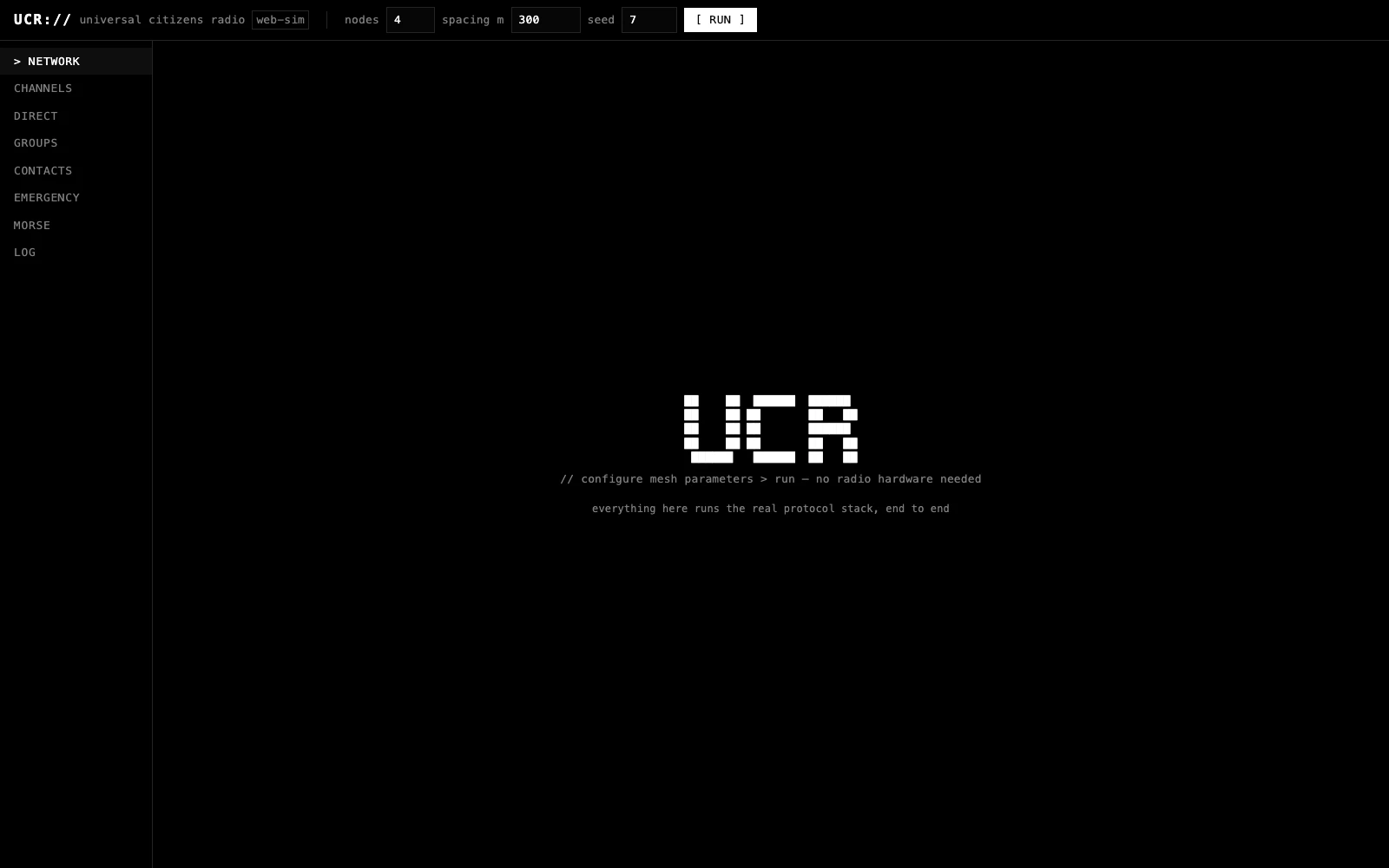
An open, decentralised radio network: encrypted messages hop node to node across a mesh, with no server, account or internet required.
- PROTOCOL
- Rust workspace, nine crates, no_std wire format
- CRYPTO
- Ed25519 identity, X25519 + ChaCha20-Poly1305 E2E
- MESH
- Scoped flooding, RREQ/RREP, store-and-forward
- APP
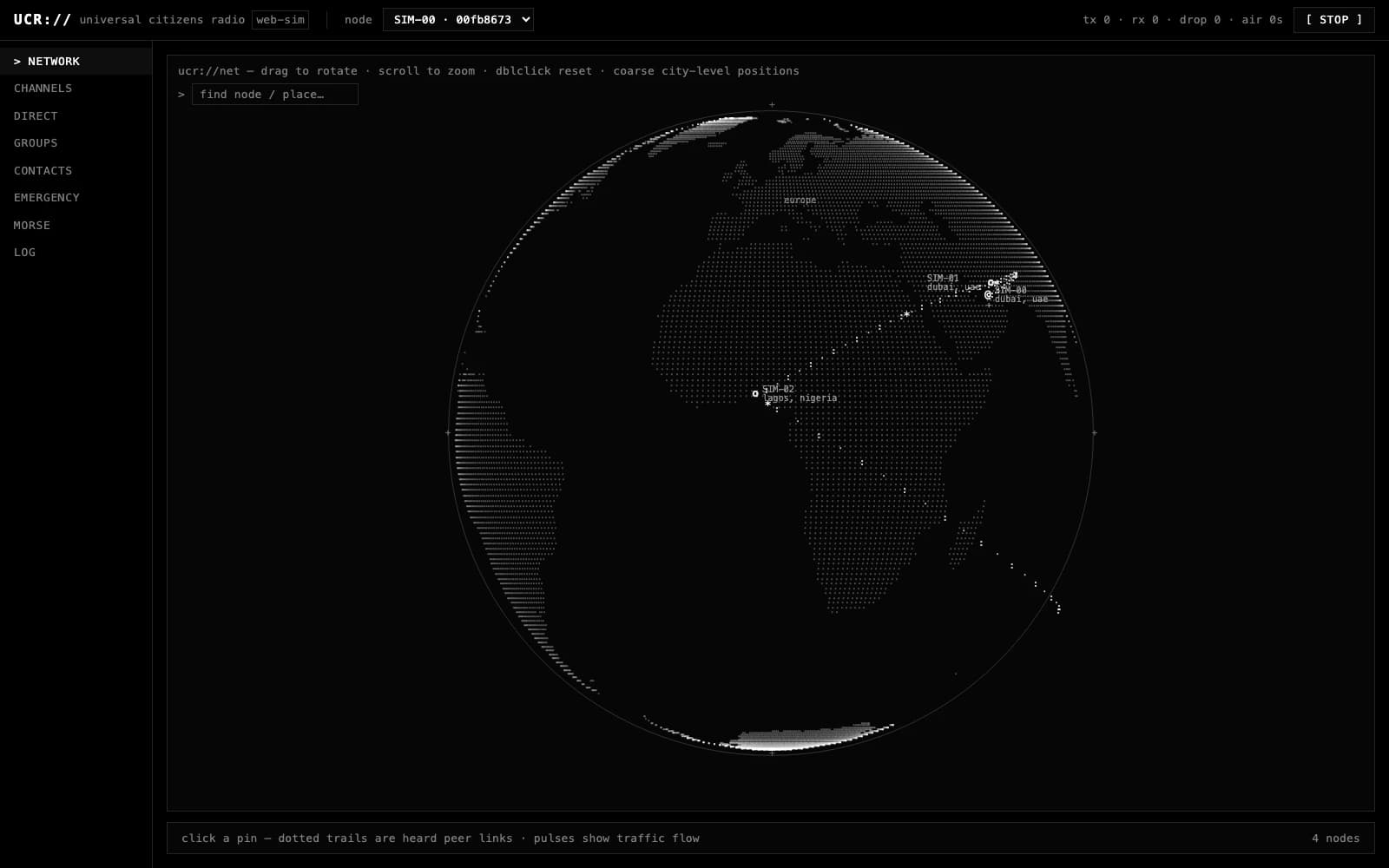
- Tauri 2 desktop, ASCII globe network view
- SIMULATOR
- Deterministic RF sim, 13-scenario suite
- FIRMWARE
- ESP32-S3 + SX1262 reference modem
- LICENSE
- Apache 2.0
Overview
UCR, Universal Citizens Radio, is an open, decentralised and hardware-independent digital radio platform. Compatible devices exchange signed and encrypted messages over an intelligent multi-hop RF mesh: no central server, no account, no internet required.
It is built for general public communication, private messaging, group channels and emergency preparedness. Public channels, encrypted DMs, groups with invites, priority emergency broadcasts and a digital Morse mode all run on the same protocol stack.
Why it exists
Normal messaging stops working exactly when it matters most: no signal, no network, nothing between you and whoever you are trying to reach. UCR is the opposite architecture. Every device is a node, every node relays, and identity is a key you hold rather than an account someone hosts.
Approach
The core is a Rust workspace with a no_std wire format: identity is Ed25519 keys with NodeIds derived from BLAKE3, sessions run ephemeral X25519 plus ChaCha20-Poly1305, and every packet stays signed end to end, even across relays. The router does scoped flooding, designated-next-hop unicast, passive route learning and store-and-forward with acks and retries.
The whole stack is developed against a deterministic RF simulator that models path loss, shadowing, airtime, half-duplex, collisions, listen-before-talk, duty cycle, mobility and partitions, verified by a thirteen-scenario mesh suite. The Tauri desktop app runs the real node stack in-process with a live ASCII globe view, and the reference firmware targets an ESP32-S3 plus SX1262 radio.
Status
Early development. Phase one, the protocol core, is implemented and tested: identity, crypto, routing and the simulator all pass the scenario suite. The desktop app runs over the simulator, and the reference modem firmware compiles for real Xtensa hardware. Next up is real-radio field testing and the frozen wire-format spec.